What Is a Data Lake?
Data Lake on the Cloud: A Modern Foundation for Your Data - AWS, GCP & Azure
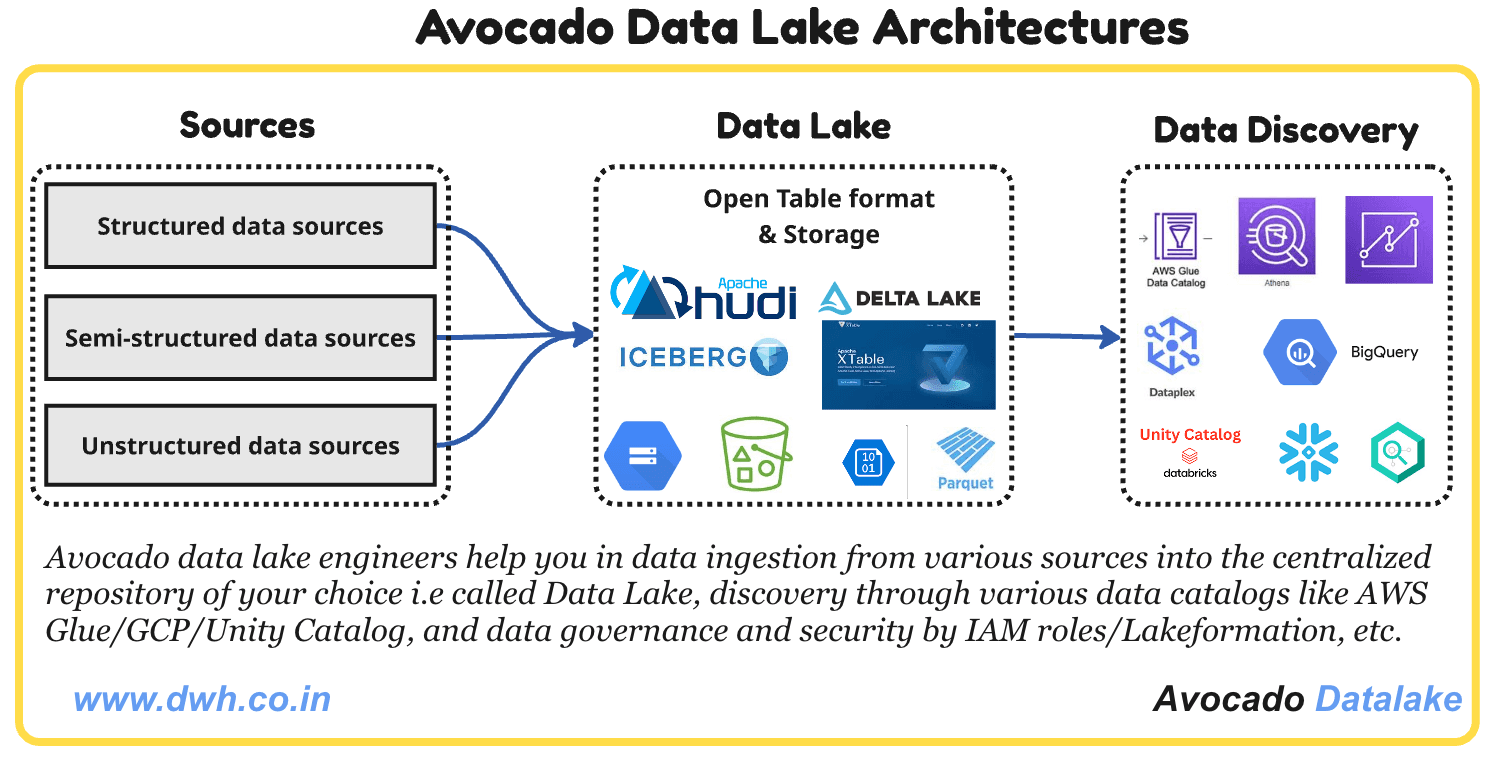
- Data lake architecture design
- Defined use cases
- AL/LLM/ML/BI/Compliance storages
- Data catalog implementation roadmap
- Cloud cost management plan
- Security & access control matrix
- Data quality & schema evolution rules
- Monitoring and alerting setup (DataOps & telemetry)
Frequently Asked Questions About Data Lakes
What is a Data Lake?
A Data Lake is a centralized repository that stores raw data in its native format — structured, semi-structured, and unstructured — at any scale. Unlike a data warehouse, it applies schema on read, giving data scientists and engineers flexibility to run ad-hoc queries, ML workloads, and batch analytics.
What is the difference between a data lake and a data warehouse?
A data lake stores raw data in any format and applies schema on read, making it ideal for exploratory analytics, machine learning, and streaming ingestion. A data warehouse stores structured, processed data with a predefined schema on write, optimized for fast SQL queries and executive BI reporting. Modern architectures combine both into a unified data lakehouse.
What open table formats are used in a modern data lake?
The three industry-standard open table formats are Apache Iceberg (hidden partitioning, time travel, broad engine support), Delta Lake (ACID transactions and Spark ecosystem integration), and Apache Hudi (fast CDC upserts with Copy-on-Write and Merge-on-Read table types).
Which cloud platforms support data lakes?
All leading cloud providers offer managed object storage and analytics engines for data lakes: Amazon Web Services (AWS S3 + AWS Glue + EMR), Google Cloud Platform (Google Cloud Storage + BigLake + Dataproc Serverless), and Microsoft Azure (Azure Data Lake Storage Gen2 + Azure Synapse).
What is a data lakehouse?
A data lakehouse unifies the low storage costs and unstructured data support of a data lake with the transactional guarantees (ACID), schema enforcement, and SQL query speed of a data warehouse by leveraging open table formats like Iceberg, Delta Lake, or Hudi.